Close Menu
Xarkas BlogXarkas Blog
    What's Hot

    OnePlus May Be Testing a 165Hz Phone With Dimensity 9500, Possibly the Ace 6 Ultra

    January 12, 2026

    Final Fantasy 14 Hosting Free Login Campaign

    January 11, 2026

    Demon Slayer Has Officially Been Beaten By Its Biggest 2025 Rival

    January 11, 2026
    Facebook X (Twitter) Instagram
    Xarkas BlogXarkas Blog
    • Tech News

      Apple Vision Pro vs Meta Quest 3: The Ultimate VR Headset Showdown

      December 3, 2025

      ChatGPT told them they were special — their families say it led to tragedy

      November 24, 2025

      Beehiiv’s CEO isn’t worried about newsletter saturation

      November 24, 2025

      TechCrunch Mobility: Searching for the robotaxi tipping point

      November 24, 2025

      X’s new About This Account feature is going great

      November 24, 2025
    • Mobiles

      OnePlus May Be Testing a 165Hz Phone With Dimensity 9500, Possibly the Ace 6 Ultra

      January 12, 2026

      Vivo X200T Full Specifications Tipped Ahead of Launch in India: Check Expected Price Range

      January 11, 2026

      Realme 16 Pro Plus vs Vivo V60 vs OPPO Reno 14: Which is the Best Smartphone Under Rs 40,000 in India (2026)?

      January 11, 2026

      Redmi 15C Review: A Large Phone That Sticks To The Basics, But Is That Enough?

      January 11, 2026

      Redmi Note 15 5G Now Available for Purchase in India Through Amazon: Check Price, Specifications, Offers

      January 11, 2026
    • Gaming

      Final Fantasy 14 Hosting Free Login Campaign

      January 11, 2026

      Demon Slayer Has Officially Been Beaten By Its Biggest 2025 Rival

      January 11, 2026

      The Best Sub-Job For Each Character

      January 11, 2026

      RPGs Where Choices Matter More Than You Expect

      January 11, 2026

      With Blade’s MCU Movie Reportedly Dead, Arkane’s Game is Under More Pressure Than Ever

      January 11, 2026
    • SEO Tips
    • PC/ Laptops

      Dell Pro 14 (AMD Ryzen AI 7 Pro 350) Review: The Sensible Choice for Everyday Office Work

      January 9, 2026

      CES 2026: MSI Unveils New Prestige, Raider, Stealth and Crosshair Laptops with Intel Core Ultra SoCs

      January 7, 2026

      CES 2026: Samsung Unveils New Galaxy Book6 Laptops

      January 6, 2026

      CES 2026: HP Shows a Keyboard-Based PC and New EliteBooks

      January 6, 2026

      CES 2026: Intel Unveils Core Ultra Series 3, Its First Platform Built on 18A

      January 6, 2026
    • EV

      Here’s How Much It Costs

      November 15, 2025

      Sodium-Ion Batteries Have Landed In America. The Hard Part Starts Now

      November 15, 2025

      Mazda Begins Testing Its Long-Overdue U.S. EV

      November 14, 2025

      Volkswagen Adds Smartwatch Support For U.S. Vehicles

      November 14, 2025

      TATA.ev expands charging footprint with 14 new manned MegaChargers across AP, Telangana

      November 14, 2025
    • Gadget
    • AI
    Facebook
    Xarkas BlogXarkas Blog
    Home - Editor's Choice - Layering stretchable and rigid materials and incorporating machine learning improves accuracy of wearables
    Editor's Choice

    Layering stretchable and rigid materials and incorporating machine learning improves accuracy of wearables

    KavishBy KavishAugust 22, 2024No Comments5 Mins Read
    Facebook Twitter Pinterest Telegram LinkedIn Tumblr WhatsApp Email
    Layering stretchable and rigid materials and incorporating machine learning improves accuracy of wearables
    Share
    Facebook Twitter LinkedIn Pinterest Telegram Email


    Layering stretchable and rigid materials and incorporating machine learning improves accuracy of wearables
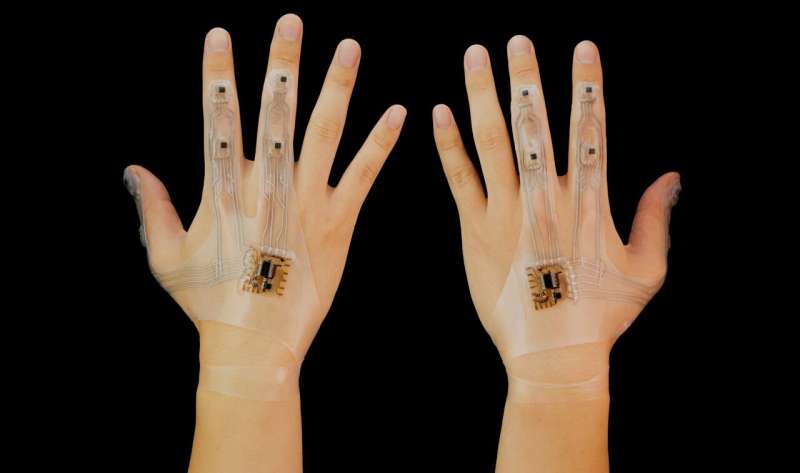
    Inertial sensors were equipped on the developed device, and the results measured by the sensors on the device can be transmitted even under 150% elongation. Credit: Yokohama National University

    Researchers at Yokohama National University have developed a stretchy, high-precision measurement wearable device that combines soft polymer materials and rigid electronic elements. This device can accurately measure inertial data even if it extends up to 2.5 times its length.

    The combination of this stretchable high-precision device and machine learning achieved multiple types of motion recognition with a high accuracy rate. The potential applications of this technology have led to the realization of systems that integrate various soft and rigid electronics with information technology.

    Stretchable, wearable devices that can sense physical and bioelectrical information quickly and accurately are increasingly being used for things like health monitoring and motion measurement. However, making a device that is stretchy enough to be comfortable and rigid enough to accurately sense data is difficult.

    Machine learning can help make these devices more powerful, but in order to integrate the technology, stretchable hybrid wearables that combine comfort and stable data processing will need to be developed.

    A paper published in Device on August 7 outlines how rigid integrated circuits layered on a flexible substrate can be used to improve wearable performance.

    “Stretchable devices combining high-performance sensor integrated circuits based on solid-state electronics have been developed, but they lack the stretchability to accommodate large deformations of more than two times elongation. These factors have limited the development of integrated systems for stretchable devices and machine learning,” said Hiroki Ota, associate professor in the Faculty of Engineering at Yokohama National University.

    In fact, Ota explained, there are no devices currently available on the market that can measure with both high accuracy and high repeatability among stretchable devices (or devices that have high deformability).

    In this study, researchers focused on developing motion capture wearables with integrated machine learning. The devices were very deformable, meaning they were flexible and could contour to the body.

    Structures called heterogeneous-rigidity protective structures were developed to provide the extra stability to the flexible wearables. These structures protected the electrical wiring and had three layers: a hard layer, an intermediate layer, and a soft layer.

    The soft layer ensured the device remained stretchy and the harder layers maintained the integrity of the sensors in the device. Liquid metal paste was also used throughout the device, including to develop the wiring, to ensure the device remained flexible.

    “The fusion of stretchable materials and solid-state electronics-based rigid elements realizes novel devices that combine elasticity with high computing and measurement capabilities. These devices promote integration with machine learning systems, where data reproducibility is critical,” said Ota.

    To test the power of the wearable device, researchers performed three tasks: self-shape estimation of knots, recognizing writing in the air, and sign-language recognition. Researchers also tested how well the device continued to work as it was stretched.

    When compared to previous iterations of wearable devices that only have a circuit board, the newly developed device with the heterogeneous-rigidity protective structure was better at handling elongation and stretching. The device with only the circuit board and soft layer showed strain at 30% elongation and it broke at 100% elongation.

    In comparison, at 100% elongation the device with the heterogeneous-rigidity protective structure did not show any signs of damaging strain and it continued to work even if stretched to 150%.

    The devices were also tested to see how well they performed at certain assigned tasks, including recognizing the letters spelled during finger spelling and sign-language recognition.

    Currently, wearable devices used to track finger spelling have difficulty with parallel movements without finger bending. The newly developed heterogeneous-rigidity device was able to accurately classify between 91% and 98% of the letters spelled, depending on the processing model used to analyze the data, but additional research is needed to understand differences in the training models.

    Researchers also posited that the technology could go beyond finger spelling and recognize American Sign Language, a highly sought-after technology. The challenges for developing this technology, however, go beyond the limitations of stretchable, wearable devices and additional development is needed.

    Looking ahead, researchers plan to develop more devices with this new technology.

    “Ultimately, we aim to realize stretchable hybrid electronics that integrate solid-state and stretchable electronics by utilizing the electronic properties of both rigid devices and elastic materials, and by integrating them with information processing technology,” said Ota.

    More information:
    Soft intelligent systems based on stretchable hybrid devices integrated with machine learning, Device (2024). DOI: 10.1016/j.device.2024.100496. www.cell.com/device/fulltext/S2666-9986(24)00392-2

    Provided by
    Yokohama National University


    Citation:
    Layering stretchable and rigid materials and incorporating machine learning improves accuracy of wearables (2024, August 7)
    retrieved 22 August 2024
    from https://techxplore.com/news/2024-08-layering-stretchable-rigid-materials-incorporating.html

    This document is subject to copyright. Apart from any fair dealing for the purpose of private study or research, no
    part may be reproduced without the written permission. The content is provided for information purposes only.


    Source link

    Share. Facebook Twitter Pinterest LinkedIn Tumblr Email
    Kavish
    • Website

    Related Posts

    OnePlus May Be Testing a 165Hz Phone With Dimensity 9500, Possibly the Ace 6 Ultra

    January 12, 2026

    Final Fantasy 14 Hosting Free Login Campaign

    January 11, 2026

    Demon Slayer Has Officially Been Beaten By Its Biggest 2025 Rival

    January 11, 2026

    Vivo X200T Full Specifications Tipped Ahead of Launch in India: Check Expected Price Range

    January 11, 2026

    The Best Sub-Job For Each Character

    January 11, 2026

    Realme 16 Pro Plus vs Vivo V60 vs OPPO Reno 14: Which is the Best Smartphone Under Rs 40,000 in India (2026)?

    January 11, 2026

    Comments are closed.

    Top Reviews
    Editors Picks

    OnePlus May Be Testing a 165Hz Phone With Dimensity 9500, Possibly the Ace 6 Ultra

    January 12, 2026

    Final Fantasy 14 Hosting Free Login Campaign

    January 11, 2026

    Demon Slayer Has Officially Been Beaten By Its Biggest 2025 Rival

    January 11, 2026

    Vivo X200T Full Specifications Tipped Ahead of Launch in India: Check Expected Price Range

    January 11, 2026
    About Us
    About Us

    Email Us: info@xarkas.com

    Facebook Pinterest
    © 2026 . Designed by Xarkas Technologies.
    • Home
    • Mobiles
    • Privacy Policy

    Type above and press Enter to search. Press Esc to cancel.

    Ad Blocker Enabled!
    Ad Blocker Enabled!
    Our website is made possible by displaying online advertisements to our visitors. Please support us by disabling your Ad Blocker.