


A sustainable source for clean energy may lie in old soda cans and seawater. MIT engineers have found that when the aluminum in soda cans is exposed in its pure form and mixed with seawater, the solution bubbles up and naturally produces hydrogen—a gas that can be subsequently used to power an engine or fuel cell without generating carbon emissions. What’s more, this simple reaction can be sped up by adding a common stimulant: caffeine.
In a study appearing today in the journal Cell Reports Physical Science, the researchers show they can produce hydrogen gas by dropping pretreated, pebble-sized aluminum pellets into a beaker of filtered seawater. The aluminum is pretreated with a rare-metal alloy that effectively scrubs aluminum into a pure form that can react with seawater to generate hydrogen. The salt ions in the seawater can in turn attract and recover the alloy, which can be reused to generate more hydrogen in a sustainable cycle.
The team found that this reaction between aluminum and seawater successfully produces hydrogen gas, though slowly. On a lark, they tossed into the mix some coffee grounds and found, to their surprise, that the reaction picked up its pace.
In the end, the team discovered that a low concentration of imidazole—an active ingredient in caffeine—is enough to significantly speed up the reaction, producing the same amount of hydrogen in just five minutes, compared to two hours without the added stimulant.
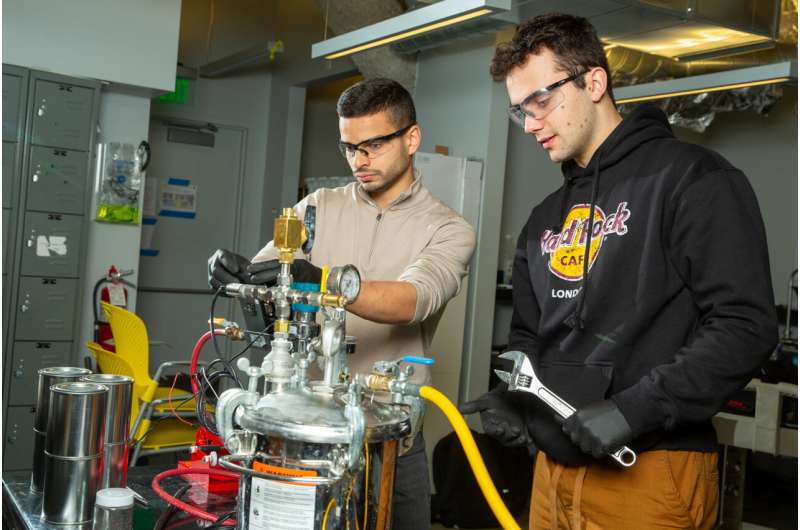
The researchers are developing a small reactor that could run on a marine vessel or underwater vehicle. The vessel would hold a supply of aluminum pellets (recycled from old soda cans and other aluminum products), along with a small amount of gallium-indium and caffeine. These ingredients could be periodically funneled into the reactor, along with some of the surrounding seawater, to produce hydrogen on demand. The hydrogen could then fuel an onboard engine to drive a motor or generate electricity to power the ship.
“This is very interesting for maritime applications like boats or underwater vehicles because you wouldn’t have to carry around seawater—it’s readily available,” says study lead author Aly Kombargi, a Ph.D. student in MIT’s Department of Mechanical Engineering.
“We also don’t have to carry a tank of hydrogen. Instead, we would transport aluminum as the ‘fuel,” and just add water to produce the hydrogen that we need.”
The study’s co-authors include Enoch Ellis, an undergraduate in chemical engineering; Peter Godart Ph.D. ’21, who has founded a company to recycle aluminum as a source of hydrogen fuel; and Douglas Hart, MIT professor of mechanical engineering.
Shields up
The MIT team, led by Hart, is developing efficient and sustainable methods to produce hydrogen gas, which is seen as a “green” energy source that could power engines and fuel cells without generating climate-warming emissions.
One drawback to fueling vehicles with hydrogen is that some designs would require the gas to be carried onboard like traditional gasoline in a tank—a risky setup, given hydrogen’s volatile potential. Hart and his team have instead looked for ways to power vehicles with hydrogen without having to constantly transport the gas itself.
They found a possible workaround in aluminum—a naturally abundant and stable material that, when in contact with water, undergoes a straightforward chemical reaction that generates hydrogen and heat.
The reaction, however, comes with a sort of Catch-22: While aluminum can generate hydrogen when it mixes with water, it can only do so in a pure, exposed state. The instant aluminum meets with oxygen, such as in air, the surface immediately forms a thin, shield-like layer of oxide that prevents further reactions. This barrier is the reason hydrogen doesn’t immediately bubble up when you drop a soda can in water.
In previous work, using fresh water, the team found they could pierce aluminum’s shield and keep the reaction with water going by pretreating the aluminum with a small amount of rare metal alloy made from a specific concentration of gallium and indium. The alloy serves as an “activator,” scrubbing away any oxide buildup and creating a pure aluminum surface that is free to react with water.
When they ran the reaction in fresh, de-ionized water, they found that one pretreated pellet of aluminum produced 400 milliliters of hydrogen in just five minutes. They estimate that just 1 gram of pellets would generate 1.3 liters of hydrogen in the same amount of time.
But to further scale up the system would require a significant supply of gallium indium, which is relatively expensive and rare.
“For this idea to be cost-effective and sustainable, we had to work on recovering this alloy postreaction,” Kombargi says.
By the sea
In the team’s new work, they found they could retrieve and reuse gallium indium using a solution of ions. The ions—atoms or molecules with an electrical charge—protect the metal alloy from reacting with water and help it to precipitate into a form that can be scooped out and reused.
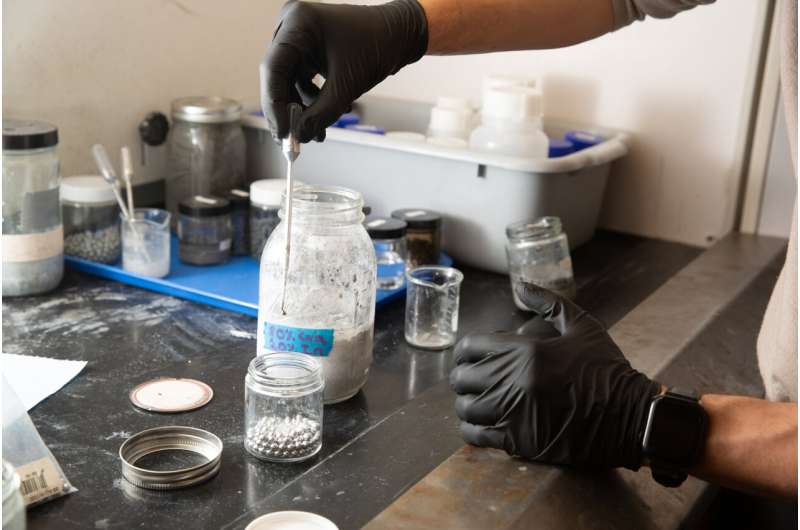
“Lucky for us, seawater is an ionic solution that is very cheap and available,” says Kombargi, who tested the idea with seawater from a nearby beach. “I literally went to Revere Beach with a friend and we grabbed our bottles and filled them, and then I just filtered out algae and sand, added aluminum to it, and it worked with the same consistent results.”
He found that hydrogen indeed bubbled up when he added aluminum to a beaker of filtered seawater. And he was able to scoop out the gallium indium afterward. But the reaction happened much more slowly than it did in fresh water. It turns out that the ions in seawater act to shield gallium indium, such that it can coalesce and be recovered after the reaction. But the ions have a similar effect on aluminum, building up a barrier that slows its reaction with water.
As they looked for ways to speed up the reaction in seawater, the researchers tried out various and unconventional ingredients.
“We were just playing around with things in the kitchen, and found that when we added coffee grounds into seawater and dropped aluminum pellets in, the reaction was quite fast compared to just seawater,” Kombargi says.
To see what might explain the speedup, the team reached out to colleagues in MIT’s chemistry department, who suggested they try imidazole—an active ingredient in caffeine, which happens to have a molecular structure that can pierce through aluminum (allowing the material to continue reacting with water), while leaving gallium indium’s ionic shield intact.
“That was our big win,” Kombargi says. “We had everything we wanted: recovering the gallium indium, plus the fast and efficient reaction.”
The researchers believe they have the essential ingredients to run a sustainable hydrogen reactor. They plan to test it first in marine and underwater vehicles. They’ve calculated that such a reactor, holding about 40 pounds of aluminum pellets, could power a small underwater glider for about 30 days by pumping in surrounding seawater and generating hydrogen to power a motor.
“We’re showing a new way to produce hydrogen fuel, without carrying hydrogen but carrying aluminum as the ‘fuel,'” Kombargi says. “The next part is to figure out how to use this for trucks, trains, and maybe airplanes. Perhaps, instead of having to carry water as well, we could extract water from the ambient humidity to produce hydrogen. That’s down the line.”
More information:
Kombargi et al. Enhanced Recovery of Activation Metals for Accelerated Hydrogen Generation from Aluminum and Seawater, Cell Reports Physical Science (2024). DOI: 10.1016/j.xcrp.2024.102121. www.cell.com/cell-reports-phys … 2666-3864(24)00399-0
This story is republished courtesy of MIT News (web.mit.edu/newsoffice/), a popular site that covers news about MIT research, innovation and teaching.
Citation:
Engineers develop a recipe for zero-emissions fuel: Soda cans, seawater and caffeine (2024, July 25)
retrieved 23 August 2024
from https://techxplore.com/news/2024-07-recipe-emissions-fuel-soda-cans.html
This document is subject to copyright. Apart from any fair dealing for the purpose of private study or research, no
part may be reproduced without the written permission. The content is provided for information purposes only.
