Close Menu
Xarkas BlogXarkas Blog
    What's Hot

    The Best Sub-Job For Each Character

    January 11, 2026

    Realme 16 Pro Plus vs Vivo V60 vs OPPO Reno 14: Which is the Best Smartphone Under Rs 40,000 in India (2026)?

    January 11, 2026

    RPGs Where Choices Matter More Than You Expect

    January 11, 2026
    Facebook X (Twitter) Instagram
    Xarkas BlogXarkas Blog
    • Tech News

      Apple Vision Pro vs Meta Quest 3: The Ultimate VR Headset Showdown

      December 3, 2025

      ChatGPT told them they were special — their families say it led to tragedy

      November 24, 2025

      Beehiiv’s CEO isn’t worried about newsletter saturation

      November 24, 2025

      TechCrunch Mobility: Searching for the robotaxi tipping point

      November 24, 2025

      X’s new About This Account feature is going great

      November 24, 2025
    • Mobiles

      Realme 16 Pro Plus vs Vivo V60 vs OPPO Reno 14: Which is the Best Smartphone Under Rs 40,000 in India (2026)?

      January 11, 2026

      Redmi 15C Review: A Large Phone That Sticks To The Basics, But Is That Enough?

      January 11, 2026

      Redmi Note 15 5G Now Available for Purchase in India Through Amazon: Check Price, Specifications, Offers

      January 11, 2026

      Realme 16 Pro Plus vs Vivo V60 vs OPPO Reno 14: Which is the Best Smartphone Under Rs 40,000 in India (2026)?

      January 10, 2026

      Realme Neo 8 Full Specifications Revealed Ahead of Launch: Could Debut as the Realme GT 8 in India

      January 10, 2026
    • Gaming

      The Best Sub-Job For Each Character

      January 11, 2026

      RPGs Where Choices Matter More Than You Expect

      January 11, 2026

      With Blade’s MCU Movie Reportedly Dead, Arkane’s Game is Under More Pressure Than Ever

      January 11, 2026

      Why the Rumoured LEGO Architecture Record‑Breaker Could Be the Most Ambitious Build of 2026

      January 11, 2026

      7 Saddest Endings In Open-World Games, Ranked

      January 10, 2026
    • SEO Tips
    • PC/ Laptops

      Dell Pro 14 (AMD Ryzen AI 7 Pro 350) Review: The Sensible Choice for Everyday Office Work

      January 9, 2026

      CES 2026: MSI Unveils New Prestige, Raider, Stealth and Crosshair Laptops with Intel Core Ultra SoCs

      January 7, 2026

      CES 2026: Samsung Unveils New Galaxy Book6 Laptops

      January 6, 2026

      CES 2026: HP Shows a Keyboard-Based PC and New EliteBooks

      January 6, 2026

      CES 2026: Intel Unveils Core Ultra Series 3, Its First Platform Built on 18A

      January 6, 2026
    • EV

      Here’s How Much It Costs

      November 15, 2025

      Sodium-Ion Batteries Have Landed In America. The Hard Part Starts Now

      November 15, 2025

      Mazda Begins Testing Its Long-Overdue U.S. EV

      November 14, 2025

      Volkswagen Adds Smartwatch Support For U.S. Vehicles

      November 14, 2025

      TATA.ev expands charging footprint with 14 new manned MegaChargers across AP, Telangana

      November 14, 2025
    • Gadget
    • AI
    Facebook
    Xarkas BlogXarkas Blog
    Home - Editor's Choice - Shakespeare in sign language, as seen through AI
    Editor's Choice

    Shakespeare in sign language, as seen through AI

    KavishBy KavishAugust 26, 2024No Comments5 Mins Read
    Facebook Twitter Pinterest Telegram LinkedIn Tumblr WhatsApp Email
    Shakespeare in sign language, as seen through AI
    Share
    Facebook Twitter LinkedIn Pinterest Telegram Email


    Shakespeare in sign language, seen through AI
    Example of the AI tools the audience saw on the monitors during the performance. Credit: SignOn project

    A new study uses co-creation with reference communities to develop an app for sign language machine translation (SLMT). The research team designed a theatrical performance in sign language, seen through the eyes of artificial intelligence (AI), as one of the methodologies.

    “Historically, deaf people have been excluded from the development of automatic translation technologies,” says Shaun O’Boyle, Research Fellow in the School of Inclusive and Special Education (Dublin City University DCU).

    “This has often caused backlash and resistance from deaf communities, as the projects were designed and developed without any input from the very end-users they intended to serve—resulting in a technology no one wanted to use and a big waste of money,” adds Davy Van Landuyt, Project Manager at the European Union of the Deaf (EUD).

    The team decided to reverse the standard approach. The results of their work are described in a paper published in the Journal of Science Communication.

    O’Boyle, Van Landuyt, and the other partners of the European project SignON—including the Vlaams GebarentaalCentrum (Flemish Sign Language Center)—designed an innovative co-creation methodology based on this idea: If we were to introduce an AI to Shakespeare texts in Irish Sign Language, which extracts would we choose first? This engagement with the AI allowed them to connect with the audience and gather their opinions about the technology.

    Shakespeare in sign language, seen through AI
    All the World’s a Screen. Credit: SignOn project

    “We looked hard at what deaf communities really wanted (and equally important didn’t want),” explains Van Landuyt.

    “It was a group effort, and it was a lot of fun,” comments O’Boyle, an expert in science communication and community engagement, who co-authored the paper with Van Landuyt, Elizabeth Mathews (who works with O’Boyle at DCU) and others.

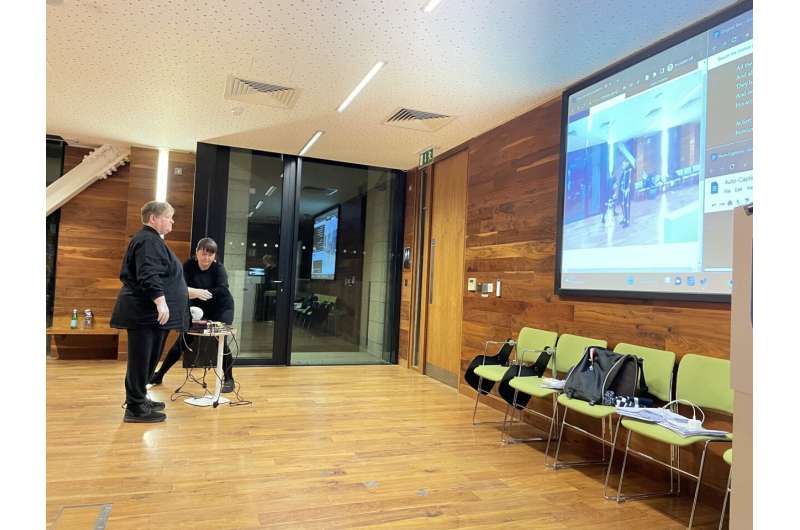
    The co-creation activity of the project, which contributed to the development of an SLMT app prototype, mixed live theatrical performance with artificial intelligence tools in a setting that reversed the stereotypical perspective between deaf/hard of hearing people and hearing people.

    “We combined performance with an audience discussion, so to have that element of a focus group technique but within the context of culture and art and seeing a show, and being out for the night,” explains O’Boyle.

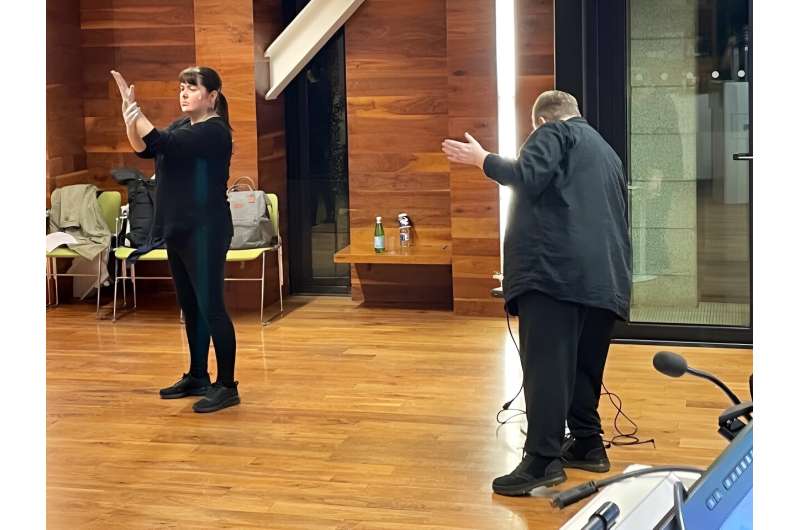
    The event, titled All the World’s a Screen, was held during Dublin’s Science Week and consisted of a theatrical performance based on the works of William Shakespeare, performed in Irish Sign Language by two deaf actors, Lianne Quigley and Alvean Jones, who are also co-authors of the research and who translated Shakespeare’s texts into Irish Sign Language. The audience was composed of deaf, hard of hearing, and hearing people.
    Shakespeare in sign language, seen through AI
    All the World’s a Screen. Credit: SignOn project

    “For deaf people, it was really important to have a performance and science engagement in their own language rather than in English. In our performance, an interpreter provided access to hearing people,” explains O’Boyle.

    “It shifted the dynamic, but it also gave people an opportunity to imagine the future of these technologies because we asked people to view the performance with their AI ‘co-spectator.'”

    During the performance, in fact, spectators could access tools for real-time analysis of the performers’ movements, object recognition, and real-time transcription of the spoken English translation by the interpreters.

    “We got so much interesting feedback and the great thing about doing it within the context of a research project was that all of that feedback went straight to our team. It informed the use cases for the app, it informed how we spoke about it, how we thought about it, and different aspects of the technology that was developed too,” says O’Boyle.

    “The ethical side is also important,” adds Van Landuyt.
    Shakespeare in sign language, seen through AI
    All the World’s a Screen. Credit: SingOn project

    “A major frustration of deaf communities are attitudes or motivations of some hearing researchers working on these technologies,” says Van Landuyt, who also explains that this leads to a waste of time and resources.

    “Too often, ‘hearing’ decision-makers or researchers think that they know better than deaf communities and try to create something which is then rejected by the actual end-users of those technologies, simply because it is not what they want or even utterly useless in practice. I think about, for example, technologies such as signing gloves.

    “Just including deaf people in a project is not a structural solution. It does not mean that they are leading the research. Deaf researchers are often only asked to collaborate after the initial idea has already been conceived, the team built, the research conducted, or even near the end of the project,” he adds.

    By engaging in authentic co-creation and science communication with deaf communities, this can be mitigated. “We cannot stop the evolution of these technologies, so we need to figure out how to deal with them. It’s essential that deaf people can decide for themselves,” concludes Van Landuyt. “Nothing about us without us.”

    More information:
    A deaf-centred art-science approach to community engagement with sign language technologies, Journal of Science Communication (2024). DOI: 10.22323/2.23050804

    Provided by
    International School of Advanced Studies (SISSA)


    Citation:
    Shakespeare in sign language, as seen through AI (2024, August 26)
    retrieved 26 August 2024
    from https://techxplore.com/news/2024-08-shakespeare-language-ai.html

    This document is subject to copyright. Apart from any fair dealing for the purpose of private study or research, no
    part may be reproduced without the written permission. The content is provided for information purposes only.


    Source link

    Share. Facebook Twitter Pinterest LinkedIn Tumblr Email
    Kavish
    • Website

    Related Posts

    The Best Sub-Job For Each Character

    January 11, 2026

    Realme 16 Pro Plus vs Vivo V60 vs OPPO Reno 14: Which is the Best Smartphone Under Rs 40,000 in India (2026)?

    January 11, 2026

    RPGs Where Choices Matter More Than You Expect

    January 11, 2026

    Redmi 15C Review: A Large Phone That Sticks To The Basics, But Is That Enough?

    January 11, 2026

    With Blade’s MCU Movie Reportedly Dead, Arkane’s Game is Under More Pressure Than Ever

    January 11, 2026

    Redmi Note 15 5G Now Available for Purchase in India Through Amazon: Check Price, Specifications, Offers

    January 11, 2026

    Comments are closed.

    Top Reviews
    Editors Picks

    The Best Sub-Job For Each Character

    January 11, 2026

    Realme 16 Pro Plus vs Vivo V60 vs OPPO Reno 14: Which is the Best Smartphone Under Rs 40,000 in India (2026)?

    January 11, 2026

    RPGs Where Choices Matter More Than You Expect

    January 11, 2026

    Redmi 15C Review: A Large Phone That Sticks To The Basics, But Is That Enough?

    January 11, 2026
    About Us
    About Us

    Email Us: info@xarkas.com

    Facebook Pinterest
    © 2026 . Designed by Xarkas Technologies.
    • Home
    • Mobiles
    • Privacy Policy

    Type above and press Enter to search. Press Esc to cancel.

    Ad Blocker Enabled!
    Ad Blocker Enabled!
    Our website is made possible by displaying online advertisements to our visitors. Please support us by disabling your Ad Blocker.