Close Menu
Xarkas BlogXarkas Blog
    What's Hot

    iQOO Z11 India Launch Timeline and Price Leaked Ahead of Launch

    May 14, 2026

    Vivo X300 Ultra, Vivo X300 FE Now Available for Purchase in India: Price, Specifications, Offers, Accessories

    May 14, 2026

    Origin Lab raises $8M to help video game companies sell data to world-model builders

    May 14, 2026
    Facebook X (Twitter) Instagram
    Xarkas BlogXarkas Blog
    • Tech News

      Hummer EV Price in India 2026: Complete Guide, Features, Specifications & Availability

      April 2, 2026

      Apple Vision Pro vs Meta Quest 3: The Ultimate VR Headset Showdown

      December 3, 2025

      ChatGPT told them they were special — their families say it led to tragedy

      November 24, 2025

      Beehiiv’s CEO isn’t worried about newsletter saturation

      November 24, 2025

      TechCrunch Mobility: Searching for the robotaxi tipping point

      November 24, 2025
    • Mobiles

      iQOO Z11 India Launch Timeline and Price Leaked Ahead of Launch

      May 14, 2026

      Vivo X300 Ultra, Vivo X300 FE Now Available for Purchase in India: Price, Specifications, Offers, Accessories

      May 14, 2026

      Samsung One UI 8.5 Update Now Available on Galaxy S Series Flagships and Foldables in India and Globally

      May 14, 2026

      Samsung’s Next Galaxy Unpacked 2026 Date Leaked: New “Wide Fold” Foldable, Smart Glasses, and More Expected

      May 13, 2026

      Samsung’s Next Galaxy Unpacked 2026 Date Leaked: New “Wide Fold” Foldable, Smart Glasses, and More Expected

      May 13, 2026
    • Gaming

      Origin Lab raises $8M to help video game companies sell data to world-model builders

      May 14, 2026

      Discord launches Nitro Rewards, giving subscribers access to the base tier of Xbox Game Pass for no extra cost

      May 12, 2026

      NYT’s Wordle to become a TV game show

      May 11, 2026

      AI Dungeon maker Latitude unveils Voyage, a platform for creating AI-powered RPGs

      April 22, 2026

      Roblox’s AI assistant gets new agentic tools to plan, build, and test games

      April 17, 2026
    • SEO Tips
    • PC/ Laptops

      Dell Pro 14 (AMD Ryzen AI 7 Pro 350) Review: The Sensible Choice for Everyday Office Work

      January 9, 2026

      CES 2026: MSI Unveils New Prestige, Raider, Stealth and Crosshair Laptops with Intel Core Ultra SoCs

      January 7, 2026

      CES 2026: Samsung Unveils New Galaxy Book6 Laptops

      January 6, 2026

      CES 2026: HP Shows a Keyboard-Based PC and New EliteBooks

      January 6, 2026

      CES 2026: Intel Unveils Core Ultra Series 3, Its First Platform Built on 18A

      January 6, 2026
    • EV

      Hummer EV Price in India 2026: Complete Guide, Features, Specifications & Availability

      April 2, 2026

      Here’s How Much It Costs

      November 15, 2025

      Sodium-Ion Batteries Have Landed In America. The Hard Part Starts Now

      November 15, 2025

      Mazda Begins Testing Its Long-Overdue U.S. EV

      November 14, 2025

      Volkswagen Adds Smartwatch Support For U.S. Vehicles

      November 14, 2025
    • Gadget
    • AI
    Facebook
    Xarkas BlogXarkas Blog
    Home - Editor's Choice - A passive, renewable, more efficient way to extract water from the atmosphere
    Editor's Choice

    A passive, renewable, more efficient way to extract water from the atmosphere

    KavishBy KavishAugust 23, 2024No Comments5 Mins Read
    Facebook Twitter Pinterest Telegram LinkedIn Tumblr WhatsApp Email
    A passive, renewable, more efficient way to extract water from the atmosphere
    Share
    Facebook Twitter LinkedIn Pinterest Telegram Email


    Plucking water from the air
    A solar-powered water harvester developed by KAUST researchers can extract 2-3 liters of water per day during the summer months. Credit: 2024 KAUST; Heno Hwang

    Freshwater scarcity affects over two billion people in the world, primarily in arid and remote regions, as well as islands and coastal areas without freshwater sources. Climate change and population growth are only making the problem worse, and existing methods require an energy input, usually electrical.

    Renewable energy can fix this and is required for these regions for drinking water and irrigation, using water extracted from the atmosphere. (It is estimated the atmosphere holds about 13 trillion tons of water, six times the freshwater in the globe’s rivers; global warming allows the air to hold more water vapor, by a theoretical 7% per degree Celsius of warming.)

    Now engineers and scientists from Saudi Arabia and China have created a system that uses solar energy to extract as much as 3 liters (0.8 gallons) of water per square meter per day from air, in a purely passive way, requiring no maintenance or human operators. The study is published in the journal Nature Communications.

    The system was tested by using its collected water to successfully grow cabbage during two seasons in Thuwal, Saudi Arabia.

    “We aim to implement this technology to produce water from the air to compensate the water needs for sustainable agriculture required for secured food production in the Middle East,” said Yu Han, a co-author from South China University of Technology.

    Existing solar-driven atmospheric water extraction (SAWE) systems typically rely on absorbing water vapor from the air. When the absorbing material reaches saturation, the system is sealed and exposed to sunlight, which begins the release of the captured water. They are an improvement over passive atmospheric water technologies such as fog and dew collection, and more available in other geographies and sites with climate constraints.

    But such SAWE systems allow only one absorption-release cycle per day, capturing moisture at night and desorbing in during the day, with the slow absorption phase limiting how much water can be extracted.

    Their widespread adoption is also limited by costly absorbing nanomaterials, challenges scaling up prototypes, while switching cycles requires either an active system which is prone to breakdown or a labor-intensive operation with moving parts, making the systems complex and energy intensive.
    A passive, renewable, more efficient way to extract water from the atmosphere
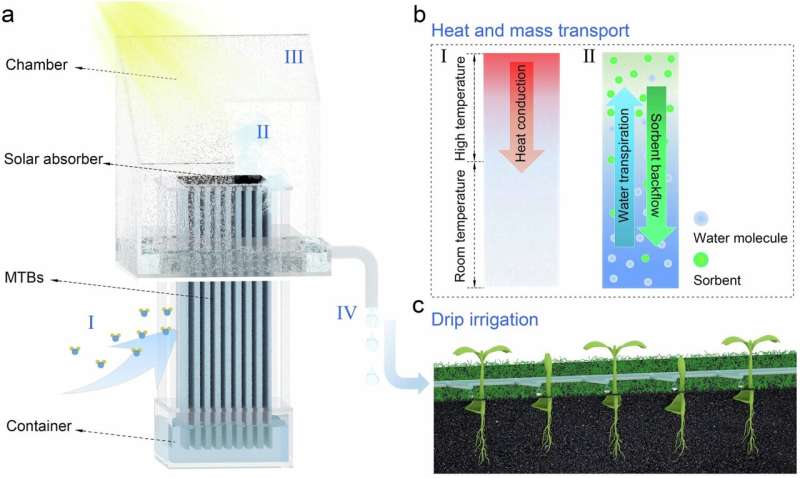
    Schematic of the passive SAWE system. Left: The container at the lower end of the mass transport bridges captures water. In the upper end, which is enclosed solar energy drives water generation. This collects on the container’s inner walls, then leaves the system as freshwater. Right: heat and mass transport in the mass transport bridges. Credit: Creative Commons Attribution 4.0 International License

    To design a passive, efficient, easily scalable and minimal-labor system, the group used a structure of multiple vertical microchannels, called mass transport bridges. The tubes, sitting in a container, are filled with a liquid salt solution that acts as a liquid absorber; they used lithium chloride.

    Depending on the temperature distribution, the ambient temperature region, exposed to the environment, continuously captures atmospheric water and stores it in a container. When the system receives sunlight, the absorber converts the light into heat and generates concentrated water vapor in the high-temperature region.

    The water vapor condenses on the chamber wall, producing freshwater. More captured water from the absorber’s container moves uninterrupted to the high-temperature region.

    At the same time, the concentrated liquid in the high-temperature region is transported back to the ambient temperature region via diffusion—the movement of molecules from a region of high concentration to low concentration—and by convection—the movement of the hotter, lower density solution through the colder, denser regions—enabling continuous capture of water vapor as long as sunlight is available.

    To implement this system, the team created a solar absorber out of partially oxidized carbon nanotubes onto a glass fiber membrane. The blackness of carbon nanotubes and the light-trapping microstructures absorbed about 96% of sunlight when wet. They found that the optimum heights for the vapor generation zone and atmospheric water capture zone were 3 and 5 cm, respectively.

    To test this setup over an eight-day production period, they used eight hours of a sun’s worth of illumination followed by 16 hours of darkness. They found that as the relative humidity increased from 60% to 90%, the water production rate increased from about 0.04 to about 0.65 kilograms per square meter per hour.

    As a real-world test in the field in Saudi Arabia, the evaporation area was increased to 13.5 cm by 24 cm, 36 times larger than the prototype. This configuration produced 2.9 liters per square meter per day, varying by the solar energy received and the relative humidity.

    This amount is four times larger than an atmospheric water project from 2021 and 27 times higher than a SAWE from 2017.

    In a test in Papua New Guinea, this increased to 4.6 liters per square meter per day. “Remarkably, the harvested water was successfully utilized for off-grid irrigation of Brassica rapa (Chinese cabbage),” said co-author Qiaoqiang Gan from King Abdullah University of Science and Technology in Saudi Arabia, “demonstrating the potential for maintenance-free horticulture in areas without access to liquid water sources.”

    More information:
    Kaijie Yang et al, A solar-driven atmospheric water extractor for off-grid freshwater generation and irrigation, Nature Communications (2024). DOI: 10.1038/s41467-024-50715-0

    © 2024 Science X Network

    Citation:
    A passive, renewable, more efficient way to extract water from the atmosphere (2024, July 29)
    retrieved 23 August 2024
    from https://techxplore.com/news/2024-07-passive-renewable-efficient-atmosphere.html

    This document is subject to copyright. Apart from any fair dealing for the purpose of private study or research, no
    part may be reproduced without the written permission. The content is provided for information purposes only.


    Source link

    Share. Facebook Twitter Pinterest LinkedIn Tumblr Email
    Kavish
    • Website

    Related Posts

    iQOO Z11 India Launch Timeline and Price Leaked Ahead of Launch

    May 14, 2026

    Vivo X300 Ultra, Vivo X300 FE Now Available for Purchase in India: Price, Specifications, Offers, Accessories

    May 14, 2026

    Origin Lab raises $8M to help video game companies sell data to world-model builders

    May 14, 2026

    Samsung One UI 8.5 Update Now Available on Galaxy S Series Flagships and Foldables in India and Globally

    May 14, 2026

    Samsung’s Next Galaxy Unpacked 2026 Date Leaked: New “Wide Fold” Foldable, Smart Glasses, and More Expected

    May 13, 2026

    Samsung’s Next Galaxy Unpacked 2026 Date Leaked: New “Wide Fold” Foldable, Smart Glasses, and More Expected

    May 13, 2026

    Comments are closed.

    Top Reviews
    Editors Picks

    iQOO Z11 India Launch Timeline and Price Leaked Ahead of Launch

    May 14, 2026

    Vivo X300 Ultra, Vivo X300 FE Now Available for Purchase in India: Price, Specifications, Offers, Accessories

    May 14, 2026

    Origin Lab raises $8M to help video game companies sell data to world-model builders

    May 14, 2026

    Samsung One UI 8.5 Update Now Available on Galaxy S Series Flagships and Foldables in India and Globally

    May 14, 2026
    About Us
    About Us

    Email Us: info@xarkas.com

    Facebook Pinterest
    © 2026 . Designed by Xarkas Technologies.
    • Home
    • Mobiles
    • Privacy Policy

    Type above and press Enter to search. Press Esc to cancel.

    Ad Blocker Enabled!
    Ad Blocker Enabled!
    Our website is made possible by displaying online advertisements to our visitors. Please support us by disabling your Ad Blocker.