


Peel apart a smartphone, fitness tracker or virtual reality headset, and inside you’ll find a tiny motion sensor tracking its position and movement. Bigger, more expensive versions of the same technology, about the size of a grapefruit and a thousand times more accurate, help navigate ships, airplanes and other vehicles with GPS assistance.
Now, scientists are attempting to make a motion sensor so precise it could minimize the nation’s reliance on global positioning satellites. Until recently, such a sensor—a thousand times more sensitive than today’s navigation-grade devices—would have filled a moving truck. But advancements are dramatically shrinking the size and cost of this technology.
For the first time, researchers from Sandia National Laboratories have used silicon photonic microchip components to perform a quantum sensing technique called atom interferometry, an ultra-precise way of measuring acceleration. It is the latest milestone toward developing a kind of quantum compass for navigation when GPS signals are unavailable.
The team published its findings and introduced a new high-performance silicon photonic modulator—a device that controls light on a microchip—as the cover story in the journal Science Advances.
The research was supported by Sandia’s Laboratory Directed Research and Development program. It took place, in part, at the National Security Photonics Center, a collaborative research center developing integrated photonics solutions for complex problems in the national security sector.
GPS-free navigation a matter of national security
“Accurate navigation becomes a challenge in real-world scenarios when GPS signals are unavailable,” said Sandia scientist Jongmin Lee.
In a war zone, these challenges pose national security risks, as electronic warfare units can jam or spoof satellite signals to disrupt troop movements and operations.
Quantum sensing offers a solution.
“By harnessing the principles of quantum mechanics, these advanced sensors provide unparalleled accuracy in measuring acceleration and angular velocity, enabling precise navigation even in GPS-denied areas,” Lee said.
Modulator the centerpiece of a chip-scale laser system
Typically, an atom interferometer is a sensor system that fills a small room. A complete quantum compass—more precisely called a quantum inertial measurement unit—would require six atom interferometers.
But Lee and his team have been finding ways to reduce its size, weight and power needs. They have already replaced a large, power-hungry vacuum pump with an avocado-sized vacuum chamber and consolidated several components usually delicately arranged across an optical table into a single, rigid apparatus.
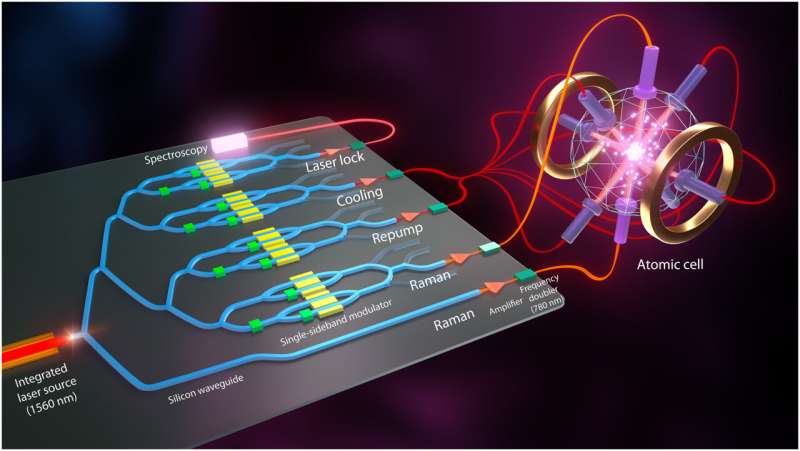
The new modulator is the centerpiece of a laser system on a microchip. Rugged enough to handle heavy vibrations, it would replace a conventional laser system typically the size of a refrigerator.
Lasers perform several jobs in an atom interferometer, and the Sandia team uses four modulators to shift the frequency of a single laser to perform different functions.
However, modulators often create unwanted echoes called sidebands that need to be mitigated.
Sandia’s suppressed-carrier, single-sideband modulator reduces these sidebands by an unprecedented 47.8 decibels—a measure often used to describe sound intensity but also applicable to light intensity—resulting in a nearly 100,000-fold drop.
“We have drastically improved the performance compared to what’s out there,” said Sandia scientist Ashok Kodigala.
Silicon device mass-producible and more affordable
Besides size, cost has been a major obstacle to deploying quantum navigation devices. Every atom interferometer needs a laser system, and laser systems need modulators.
“Just one full-size single-sideband modulator, a commercially available one, is more than $10,000,” Lee said.
Miniaturizing bulky, expensive components into silicon photonic chips helps drive down these costs.
“We can make hundreds of modulators on a single 8-inch wafer and even more on a 12-inch wafer,” Kodigala said.
And since they can be manufactured using the same process as virtually all computer chips, “This sophisticated four-channel component, including additional custom features, can be mass-produced at a much lower cost compared to today’s commercial alternatives, enabling the production of quantum inertial measurement units at a reduced cost,” Lee said.
As the technology gets closer to field deployment, the team is exploring other uses beyond navigation. Researchers are investigating whether it could help locate underground cavities and resources by detecting the tiny changes these make to Earth’s gravitational force. They also see potential for the optical components they invented, including the modulator, in LIDAR, quantum computing and optical communications.
“I think it’s really exciting,” Kodigala said. “We’re making a lot of progress in miniaturization for a lot of different applications.”
Multidisciplinary team lifting quantum compass concept to reality
Lee and Kodigala represent two halves of a multidisciplinary team. One half, including Lee, consists of experts in quantum mechanics and atomic physics. The other half, like Kodigala, are specialists in silicon photonics—think of a microchip, but instead of electricity running through its circuits, there are beams of light.
These teams collaborate at Sandia’s Microsystems Engineering, Science and Applications complex, where researchers design, produce and test chips for national security applications.
“We have colleagues that we can go down the hall and talk to about this and figure out how to solve these key problems for this technology to get it out into the field,” said Peter Schwindt, a quantum sensing scientist at Sandia.
The team’s grand plan—to turn atom interferometers into a compact quantum compass—bridges the gap between basic research at academic institutions and commercial development at tech companies. An atom interferometer is a proven technology that could be an excellent tool for GPS-denied navigation. Sandia’s ongoing efforts aim to make it more stable, fieldable and commercially viable.
The National Security Photonics Center collaborates with industry, small businesses, academia and government agencies to develop new technologies and help launch new products. Sandia has hundreds of issued patents and dozens more in prosecution that support its mission.
“I have a passion around seeing these technologies move into real applications,” Schwindt said.
Michael Gehl, a Sandia scientist who works with silicon photonics, shares the same passion. “It’s great to see our photonics chips being used for real-world applications,” he said.
More information:
Ashok Kodigala et al, High-performance silicon photonic single-sideband modulators for cold-atom interferometry, Science Advances (2024). DOI: 10.1126/sciadv.ade4454
Citation:
Quantum sensing milestone draws closer to exquisitely accurate, GPS-free navigation (2024, August 13)
retrieved 22 August 2024
from https://techxplore.com/news/2024-08-quantum-milestone-closer-exquisitely-accurate.html
This document is subject to copyright. Apart from any fair dealing for the purpose of private study or research, no
part may be reproduced without the written permission. The content is provided for information purposes only.
