Close Menu
Xarkas BlogXarkas Blog
    What's Hot

    Samsung Teases Galaxy Unpacked With a New Foldable Form Factor

    July 1, 2026

    Samsung Galaxy A27 5G with Snapdragon 6 Gen 3 SoC Launched in India: Check Price, Specifications, Offers

    July 1, 2026

    Nothing Phone 4a Series Price Hike Alert! Now Costs Up to ₹9,000 More Than Launch Price

    July 1, 2026
    Facebook X (Twitter) Instagram
    Xarkas BlogXarkas Blog
    • Tech News

      Hummer EV Price in India 2026: Complete Guide, Features, Specifications & Availability

      April 2, 2026

      Apple Vision Pro vs Meta Quest 3: The Ultimate VR Headset Showdown

      December 3, 2025

      ChatGPT told them they were special — their families say it led to tragedy

      November 24, 2025

      Beehiiv’s CEO isn’t worried about newsletter saturation

      November 24, 2025

      TechCrunch Mobility: Searching for the robotaxi tipping point

      November 24, 2025
    • Mobiles

      Samsung Teases Galaxy Unpacked With a New Foldable Form Factor

      July 1, 2026

      Samsung Galaxy A27 5G with Snapdragon 6 Gen 3 SoC Launched in India: Check Price, Specifications, Offers

      July 1, 2026

      Nothing Phone 4a Series Price Hike Alert! Now Costs Up to ₹9,000 More Than Launch Price

      July 1, 2026

      Apple iPhone 18 Pro Reportedly Leaked Ahead of Launch

      June 30, 2026

      Samsung Galaxy M47 5G with Snapdragon 6 Gen 3 SoC, Six Android OS Updates, 6000mAh Battery Launched in India

      June 30, 2026
    • Gaming

      Xbox follows Apple with price increases 

      June 26, 2026

      Ubisoft co-founder Claude Guillemot dies in plane crash

      June 22, 2026

      MapTap, a daily geography game, is my new Wordle

      June 18, 2026

      Netflix expands revamped mobile app across Asia and doubles down on kids’ gaming

      June 10, 2026

      Oura Ring 5 review: Thinner, lighter, better

      June 4, 2026
    • SEO Tips
    • PC/ Laptops

      Dell Pro 14 (AMD Ryzen AI 7 Pro 350) Review: The Sensible Choice for Everyday Office Work

      January 9, 2026

      CES 2026: MSI Unveils New Prestige, Raider, Stealth and Crosshair Laptops with Intel Core Ultra SoCs

      January 7, 2026

      CES 2026: Samsung Unveils New Galaxy Book6 Laptops

      January 6, 2026

      CES 2026: HP Shows a Keyboard-Based PC and New EliteBooks

      January 6, 2026

      CES 2026: Intel Unveils Core Ultra Series 3, Its First Platform Built on 18A

      January 6, 2026
    • EV

      Hummer EV Price in India 2026: Complete Guide, Features, Specifications & Availability

      April 2, 2026

      Here’s How Much It Costs

      November 15, 2025

      Sodium-Ion Batteries Have Landed In America. The Hard Part Starts Now

      November 15, 2025

      Mazda Begins Testing Its Long-Overdue U.S. EV

      November 14, 2025

      Volkswagen Adds Smartwatch Support For U.S. Vehicles

      November 14, 2025
    • Gadget
    • AI
    Facebook
    Xarkas BlogXarkas Blog
    Home - Editor's Choice - Engineers conduct first in-orbit test of ‘swarm’ satellite autonomous navigation
    Editor's Choice

    Engineers conduct first in-orbit test of ‘swarm’ satellite autonomous navigation

    KavishBy KavishAugust 22, 2024No Comments4 Mins Read
    Facebook Twitter Pinterest Telegram LinkedIn Tumblr WhatsApp Email
    Engineers conduct first in-orbit test of ‘swarm’ satellite autonomous navigation
    Share
    Facebook Twitter LinkedIn Pinterest Telegram Email


    Engineers conduct first in-orbit test of 'swarm' satellite autonomous navigation
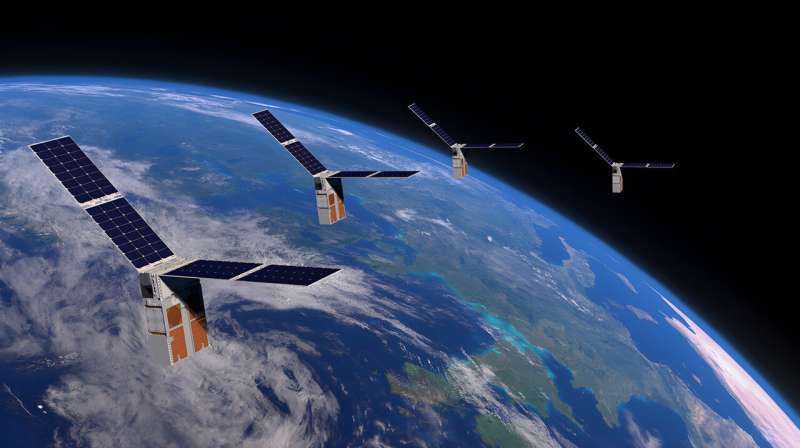
    Artist’s illustration of the swarm. Credit: NASA/Blue Canyon Technologies

    Someday, instead of large, expensive individual space satellites, teams of smaller satellites—known by scientists as a “swarm”—will work in collaboration, enabling greater accuracy, agility, and autonomy. Among the scientists working to make these teams a reality are researchers at Stanford University’s Space Rendezvous Lab, who recently completed the first-ever in-orbit test of a prototype system able to navigate a swarm of satellites using only visual information shared through a wireless network.

    “It’s a milestone paper and the culmination of 11 years of effort by my lab, which was founded with this goal of surpassing the current state of the art and practice in distributed autonomy in space,” said Simone D’Amico, associate professor of aeronautics and astronautics and senior author of the study, published on the arXiv preprint server. “Starling is the first demonstration ever made of an autonomous swarm of satellites.”

    The test is known as Starling Formation-Flying Optical Experiment, or StarFOX. In it, the team successfully navigated four small satellites working in tandem using only visual information gathered from onboard cameras to calculate their trajectories (or orbits). The researchers presented their findings from the initial StarFOX test at a gathering of swarm satellite experts at the Small Satellite Conference in Logan, Utah.
    Engineers conduct first in-orbit test of 'swarm' satellite autonomous navigation
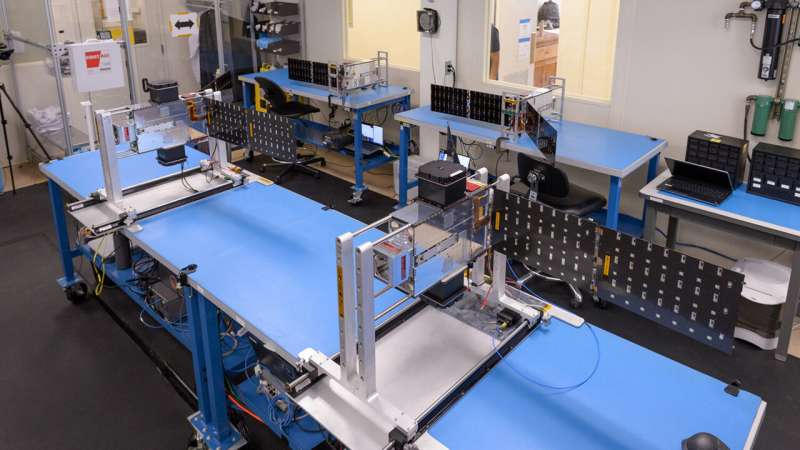
    The four swarm spacecraft during integration and testing at NASA Ames. Credit: NASA/Dominic Hart

    All the angles

    D’Amico described the challenge as one that has driven his team for more than a decade. “Our team has been advocating for distributed space systems since the lab’s inception. Now it has become mainstream. NASA, the Department of Defense, the U.S. Space Force—all have understood the value of multiple assets in coordination to accomplish objectives which would otherwise be impossible or very difficult to achieve by a single spacecraft,” he said. “Advantages include improved accuracy, coverage, flexibility, robustness, and potentially new objectives not yet imagined.”

    Robust navigation of the swarm presents a considerable technological challenge. Current systems rely on the Global Navigation Satellite System (GNSS), requiring frequent contact with terrestrial systems. Beyond Earth’s orbit, there is the Deep Space Network, but it is relatively slow and not easily scalable to future endeavors. What’s more, neither system can help satellites avoid what D’Amico calls “non-cooperative objects” like space debris that might knock a satellite out of commission.

    The swarm needs a self-contained navigation system that allows a high degree of autonomy and robustness, D’Amico said. Such systems are likewise made more attractive by minimal technical requirements and financial costs of today’s miniaturized cameras and other hardware. The cameras used in the StarFOX test are proven, relatively inexpensive 2D cameras called star-trackers found on any satellite today.

    “At its core, angles-only navigation requires no additional hardware even when used on small and inexpensive spacecraft,” D’Amico said. “And exchanging visual information between swarm members provides a new distributed optical navigation capability.”

    Written in the stars

    StarFOX combines visual measurements from single cameras mounted on each satellite in a swarm. Similar to a mariner of old navigating the high seas with a sextant, the field of known stars in the background is used as reference to extract bearing angles to the swarming satellites. These angles are then processed onboard through accurate physics-based force models to estimate the position and velocity of the satellites with respect to the orbited planet; in this case, Earth—but the moon, Mars, or other planetary objects would work as well.

    StarFOX employs the Space Rendezvous Lab’s angles-only Absolute and Relative Trajectory Measurement System—ARTMS, for short—which integrates three new space robotics algorithms. An Image Processing algorithm detects and tracks multiple targets in images and computes target-bearing angles—the angles at which objects, including space debris, are moving toward or away from each other. The Batch Orbit Determination algorithm then estimates each satellite’s coarse orbit from these angles. Last but not least, the Sequential Orbit Determination algorithm refines swarm trajectories with the processing of new images through time to potentially feed autonomous guidance, control, and collision avoidance algorithms onboard.

    More information:
    Justin Kruger et al, Starling Formation-Flying Optical Experiment: Initial Operations and Flight Results, arXiv (2024). DOI: 10.48550/arxiv.2406.06748

    Journal information:
    arXiv


    Provided by
    Stanford University


    Citation:
    Engineers conduct first in-orbit test of ‘swarm’ satellite autonomous navigation (2024, August 8)
    retrieved 22 August 2024
    from https://techxplore.com/news/2024-08-orbit-swarm-satellite-autonomous.html

    This document is subject to copyright. Apart from any fair dealing for the purpose of private study or research, no
    part may be reproduced without the written permission. The content is provided for information purposes only.


    Source link

    Share. Facebook Twitter Pinterest LinkedIn Tumblr Email
    Kavish
    • Website

    Related Posts

    Samsung Teases Galaxy Unpacked With a New Foldable Form Factor

    July 1, 2026

    Samsung Galaxy A27 5G with Snapdragon 6 Gen 3 SoC Launched in India: Check Price, Specifications, Offers

    July 1, 2026

    Nothing Phone 4a Series Price Hike Alert! Now Costs Up to ₹9,000 More Than Launch Price

    July 1, 2026

    Apple iPhone 18 Pro Reportedly Leaked Ahead of Launch

    June 30, 2026

    Samsung Galaxy M47 5G with Snapdragon 6 Gen 3 SoC, Six Android OS Updates, 6000mAh Battery Launched in India

    June 30, 2026

    iPhone 18 Pro and iPhone Ultra Launch Timeline Tipped

    June 30, 2026

    Comments are closed.

    Top Reviews
    Editors Picks

    Samsung Teases Galaxy Unpacked With a New Foldable Form Factor

    July 1, 2026

    Samsung Galaxy A27 5G with Snapdragon 6 Gen 3 SoC Launched in India: Check Price, Specifications, Offers

    July 1, 2026

    Nothing Phone 4a Series Price Hike Alert! Now Costs Up to ₹9,000 More Than Launch Price

    July 1, 2026

    Apple iPhone 18 Pro Reportedly Leaked Ahead of Launch

    June 30, 2026
    About Us
    About Us

    Email Us: info@xarkas.com

    Facebook Pinterest
    © 2026 . Designed by Xarkas Technologies.
    • Home
    • Mobiles
    • Privacy Policy

    Type above and press Enter to search. Press Esc to cancel.

    Ad Blocker Enabled!
    Ad Blocker Enabled!
    Our website is made possible by displaying online advertisements to our visitors. Please support us by disabling your Ad Blocker.